
Second Time Around with High HbA1C

About 18 years ago, I did a fingerstick test and found my BGL was over 35 mmol/L. After a few weeks, my BG was much lower, and my GP arranged two glucose tolerance tests, which I passed. He was clearly of the mind that diet changes and exercise should be tried before medication, although he wrote "DIABETIC" across my medical file.
At that time, I got a Jack Russell, went running two or three times daily, and stopped eating high-carbohydrate snacks. Random fingerstick tests gave readings around 4.5 away from meals.
High HbA1c and medication changes
In May 2025, I had a blood test and was told my HbA1c was 113, and my GP put me on metformin. My BG plummeted, and my abdomen felt so uncomfortable that I asked for an alternative and was prescribed dapagliflozin. After eleven months, a blood test showed my HbA1c to be 39; by then, I was not taking diabetes medication, or any medication.
Weight loss and fasting
I had tried fasting, and that made my BG fall too low, especially at night, which was why I stopped taking dapagliflozin. I cut back on processed foods and often have only two meals a day, often eating nothing after 4 p.m. Fasting for me is a good way to lose weight, but I don't fast often. I probably should have smaller meals, but my abdomen is flat now, so why?
Health improvements and continuous glucose monitoring
A week ago, I fasted for 36 hours, and my BG went lower than usual, leaving my fasting BG around 4.5. Since it had been over 8.0 in May 2025, this was a big change, and I noticed an improvement in my retinal edema and an almost-resolved finger joint inflammation. I don't have other diabetes complications, with my cholesterol levels, triglyceride levels, and blood pressure all good.
Lately, I have started increasing my carbohydrate intake, but not greatly, and I avoid foods with saturated fats. Ancient seeds help reduce any blood glucose spikes, but the spikes have become much smaller now.
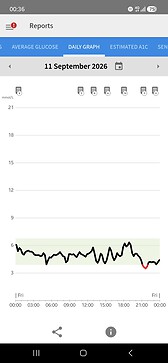
I wear a FreeStyle Libre 2 Plus CGM (continuous glucose monitor), and after my last fast, the range has narrowed. I have attached my September 11th chart, which was created by the Abbott software. I guess after a week or two, I should fast again for perhaps 24–36 hours.
Daily meals and tracking glucose spikes
I got up late, and at 12:15 p.m. had ancient grains with almond milk, nuts, an egg, a few small carrots, sugar snap peas, small tomatoes, strawberries, and grapes, with a crispbread and Roulade garlic cheese, and coffee with cream. Months ago, this would have created a big BG spike, but not now, with the aid of exercise and grains.
At 15:15, I had a chicken curry with rice and dahl, lime pickle, a small glass of white wine, a zero-sugar drink, and some nuts. My metabolism handled this much better than it would have some months ago, when my BG would have spiked high. I omitted the grains to see if exercise alone would suffice to kill off the expected spike. At 15:50, I had a quarter of a cheesecake with coffee and cream, which added to the glucose load of the curry meal, but after about two more hours, my BG had fallen again. With exercise, my BG fell low.
Managing diabetes for the long term
I would likely not have accomplished this reduction in average BG without the CGM, so I will go on using one indefinitely. If I eat as I am told I should as someone with diabetes, then I think I can keep my BG stable, and I will be interested to see my next HbA1c value. I am careful with oats and high-glycemic-index grains, since these can really push my BG up. Some of the foods advised for people with diabetes seem to leave me with my BG above baseline for hours, such as soy milk. I find it better to have semi-skimmed cow's milk, since it is digested more quickly.
Both of my parents and my sister developed T2DM, with my mother having had several kinds of diabetic complications. I paid little attention after recovering from the condition the first time, until 2025, but it seems I have not left it too late at 67.
Join the conversation